What Is the Cost of a Complete NPK Fertilizer Granulating Machine?

The investment in a complete NPK fertilizer granulating machine always raises questions about cost, efficiency, and plant setup planning. Fertilizer manufacturers and entrepreneurs focus not only on the initial fertilizer manufacturing plant cost but also on the long-term benefits of reliable granulation equipment. A compound fertilizer production plant involves several processing machines, each contributing to the overall compound fertilizer plant cost. To clarify this topic, the following discussion explains the suitable raw materials, the machine features, and the factors influencing the total npk fertilizer production plant cost.


What Raw Materials Can a Complete NPK or Compound Fertilizer Production Line Process?

A complete npk fertilizer granulation line allows the use of diverse raw materials, and this flexibility directly affects fertilizer plant setup cost. Urea, ammonium chloride, ammonium sulfate, potassium chloride, and monoammonium phosphate represent common nitrogen, phosphorus, and potassium sources. In addition, calcium carbonate, dolomite powder, and bentonite often function as additives or fillers to improve granule quality. When investors consider npk fertilizer factory cost, they also evaluate material adaptability because the choice of raw materials influences process efficiency, granule hardness, and final nutrient balance.

The npk fertilizer pellet making procedure usually begins with batching equipment that measures each component accurately. Crushing machines then reduce large particles or lumps, while mixing systems homogenize the powder before granulation. With proper preparation, the raw material combination forms uniform compound fertilizer granules through disc granulators, drum granulators, or double roller extrusion granulators. This raw material versatility gives manufacturers control over product formulas and ensures that the npk fertilizer production plant cost generates long-term returns.

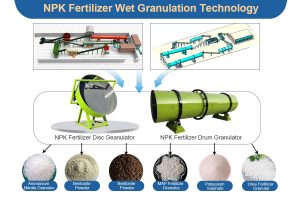
NPK Mixtures Wet Granulation Technology

What Features Define an Efficient NPK Fertilizer Granulating Machine?

A key part of compound fertilizer manufacturing is the choice of granulation equipment. Each fertilizer granulator machine type offers different advantages, and these differences influence fertilizer production line cost. A disc granulator provides simple operation and low investment, suitable for small-scale fertilizer factory setup cost. A rotary drum granulator ensures large capacity and continuous pelletizing, which suits medium to large npk fertilizer manufacturing plant cost planning. A double roller extrusion granulator reduces drying needs, which lowers energy consumption and total fertilizer production plant cost.

Besides the main granulator, other supporting fertilizer machinery also affects financial planning. A rotary drying machine and cooling machine maintain granule strength and quality while controlling moisture content. A screening machine separates qualified npk fertilizer pellets from powder or oversized particles, and a packing machine improves labor efficiency by completing automatic bagging. The integration of these machines defines the overall npk fertilizer production cost structure. Investors gain clear benefits when they select durable equipment because production stability reduces long-term compound fertilizer plant cost.


How Does Fertilizer Plant Cost Influence Business Decisions?

The fertilizer plant setup cost includes equipment purchase, installation, land use, energy supply, and labor. An investor who analyzes npk fertilizer factory cost needs to balance initial expenses with potential output capacity. A small production scale with limited fertilizer machinery requires lower fertilizer manufacturing plant cost, but it may reduce efficiency. A medium or large compound fertilizer production plant cost demands higher investment, yet it provides stable supply, better granule uniformity, and stronger market competitiveness.

In market practice, buyers often compare npk fertilizer granulator machine suppliers. Trusted equipment manufacturers usually provide not only machinery but also complete technical guidance for fertilizer granulation procedure. Cost-effective npk fertilizer production lines help reduce operational risks and ensure consistent compound fertilizer pellet quality. When investors calculate total npk fertilizer plant cost, they should consider after-sales service, spare parts supply, and equipment durability to secure long-term profitability.


Conclusion

The cost of a complete npk fertilizer granulating machine depends on raw material choice, machine features, supporting equipment, and plant scale. By selecting suitable raw materials like urea, ammonium sulfate, and potassium chloride, by evaluating granulation machinery such as disc granulators or drum granulators, and by considering auxiliary units like dryers, coolers, and packers, investors can calculate the fertilizer manufacturing plant cost more accurately.

Fertilizer entrepreneurs who aim for efficient npk fertilizer pellet production need to view cost not only as expenditure but also as investment in quality, efficiency, and market advantage. For those searching for reliable compound fertilizer production machinery, a professional fertilizer equipment manufacturer such as Yushunxin offers practical solutions and competitive fertilizer plant cost planning. You can visit: https://www.fertilizerproductequipment.com/npk-fetilizer-plant-cost/

Cost-Effective Strategies for Building Your NPK Fertilizer Production Line

Setting up an NPK fertilizer production line can be a promising venture, especially given the increasing demand for fertilizers to support global agriculture. However, it can also be a significant financial undertaking. For businesses looking to enter this industry, implementing cost-effective strategies is crucial to ensure a successful operation without straining resources. Here are some strategies that can help streamline costs of setting up an NPK fertilizer production plant.

1. Conduct Thorough Market Research

Before making any investment, conduct extensive market research. Understand the demand for NPK fertilizers in your target market, identify potential competitors, and analyze market trends. This information will help you make informed decisions about the scale and scope of your production line, ensuring that you don’t over-invest in unnecessary capacities or technologies.

2. Optimize Production Capacity

Determine the optimal production capacity based on your market research. While it might be tempting to go for the largest setup to maximize potential output, smaller, more efficient systems can be more cost-effective, especially when starting. This approach allows you to scale operations as demand grows, minimizing initial capital expenditure on NPK fertilizer manufacturing .

3. Choose the Right Technology

Invest in ecconmical  NPK fertilizer making technology that is not only cost-effective but also efficient and reliable. The choice of equipment should balance cost with functionality; opting for modern technologies that offer energy efficiency can lead to significant savings in the long run. Additionally, consider equipment with modular designs, which can be expanded or upgraded as needed.

4. Source Equipment Wisely

Consider purchasing NPK equipment from regions that offer competitive pricing without compromising on quality. Engaging with multiple suppliers and negotiating deals can also lead to cost savings.  More details.

5. Focus on Energy Efficiency

Energy costs are a significant component of operational expenses in fertilizer production. Investing in energy-efficient machinery may require a higher upfront cost but can lead to substantial savings over time. Implementing practices that reduce energy consumption, such as optimizing production schedules and regular maintenance, can further cut costs.

6. Skilled Workforce Training

Invest in training for your workforce to ensure they are skilled in operating and maintaining the machinery efficiently. An informed team can help in minimizing operational errors, reducing downtime, and maintaining the equipment in good working condition, all of which contribute to cost savings.

7. Implement Lean Manufacturing Practices

Adopt lean manufacturing principles to minimize waste and improve efficiency. This approach involves streamlining production processes, improving product flows, and reducing unnecessary inventory and overheads. Regularly reviewing processes to identify areas of waste and inefficiency will help maintain a cost-effective operation. Here, you  can visit https://fertilizerequipmentmanufacturer.com/small-scale-npk-fertilizer-production-plant-cost/ for reference.

8. Build Strong Supplier Relationships

Establishing long-term relationships with raw material suppliers can lead to better pricing and more favorable payment terms. Reliable suppliers can also provide quality materials consistently, reducing the risk of production disruptions and ensuring product quality.

9. Plan for Scalability

Design your production line with scalability in mind. Planning for future expansion can prevent costly redesigns and allow for smoother transitions as your business grows. Modular systems and easily adaptable processes will accommodate increasing demand without significant additional investment.

In conclusion, setting up an NPK fertilizer production line requires careful planning and strategic decision-making. By focusing on efficient use of resources, adopting modern technologies, and maintaining flexibility, businesses can establish a cost-effective production line that meets market demand and ensures long-term profitability. Implementing these strategies will not only optimize costs but also position the business for sustainable growth in the competitive fertilizer industry.

How To Reduce The Cost Of NPK Fertilizer Production

Reducing the cost of NPK (Nitrogen, Phosphorus, Potassium) fertilizer production involves optimizing various aspects of the production process, resource utilization, and input costs. Here are some strategies that can help minimize costs in NPK fertilizer production:

1. Optimize Raw Material Sourcing:

Seek cost-effective sources for raw materials such as nitrogen sources (urea, ammonium sulfate), phosphorus sources (phosphoric acid, rock phosphate), and potassium sources (potassium chloride, potassium sulfate). Negotiate bulk purchase agreements to secure better prices.

NPK fertilizer manufacturing by SX fertilizer equipment

2. Choose a reliable NPK fertilizer equipment manufacturer

Reliable NPK fertilizer equipment manufacturer can offer you a economical NPK fertilizer machine price. In addition, with high quality and considerate after-sales service, you can cost less on subsequent maintain and repair.

3. Energy Efficiency:

Implement energy-efficient practices in the production process. This includes optimizing NPK fertilizer equipment, using energy-efficient technologies, and exploring alternative energy sources such as renewable energy. You can choose NPK machine which mainly uses electricity and biomass as energy.

4. Process Optimization:

Regularly review and optimize the manufacturing process to identify opportunities for efficiency improvements. This might involve adjusting reaction conditions, optimizing reaction times, and minimizing waste generation. Here, SX even can design system according to you budget for NPK fertilizer plant setup.

Fast NPK fertilizer pellet making line for sale

5. Utilize By-Products:

Explore opportunities to use by-products or waste materials from other industries as inputs. For example, certain waste streams may contain valuable nutrients that can be incorporated into the NPK fertilizer.

6. Recycling:

Implement recycling systems to recover and reuse materials within the production process. Such as using screen machine to separate unqualified fertilizer to reprocess. This can reduce the need for new inputs and minimize waste disposal costs. Then, you can start NPK fertilizer making with a lower cost.

7. Advanced Production Technologies:

Investigate and adopt advanced and cost-effective technologies for fertilizer production. This might include using more efficient reactor designs, advanced automation, and modern control systems. Click here to learn more.

8. Scale Economies:

Consider scaling up production to take advantage of economies of scale. Larger production volumes can help spread fixed costs over a larger output, reducing the cost per unit.

9. Investment in Research and Development:

Invest in research and development to explore new technologies and processes that can lead to cost savings in the long term.

By implementing a combination of these strategies, fertilizer manufacturers can work towards reducing the cost of NPK fertilizer production while maintaining product quality and compliance with environmental standards. If you are finding quality NPK fertilizer machines and need precise quote, you can visit https://www.fertilizerbusinessplan.com/npk-fertilizer-plant-cost/