For fertilizer producers, distributors, and agricultural investment companies, bulk blending fertilizer production is a practical way to produce customized NPK formulas with lower processing complexity. Unlike granulation projects, a BB fertilizer plant mainly focuses on accurate batching, uniform mixing, and efficient packaging. Because of this, many investors now prefer an automatic plant when they want stable output, flexible formulas, and easier daily operation.
Higher Accuracy for Different Fertilizer Formulas
One major advantage of automation is formula accuracy. In traditional manual blending, workers need to weigh different granular materials separately, such as urea, DAP, MAP, potassium chloride, or potassium sulfate. This can easily lead to weighing errors, especially when production volume increases.
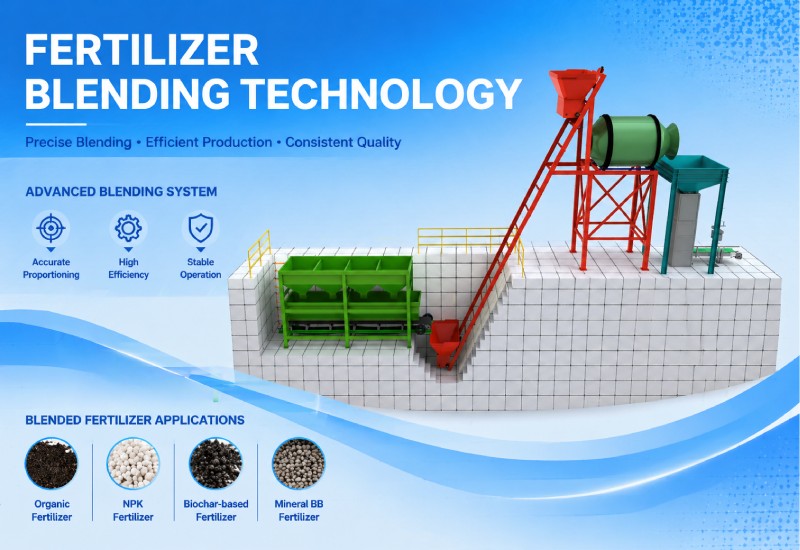
An automatic bulk fertiliser blending system uses electronic weighing, controlled feeding, and programmed batching to improve formula consistency. You can set different NPK ratios according to market demand, such as 15-15-15, 20-10-10, or other customized formulas. This helps you produce more stable fertilizer products and reduce material waste.
Better Production Efficiency and Labor Saving
A manual blending plant may be suitable for very small production, but it is difficult to support commercial fertilizer sales for a long time. When you need to process several tons or dozens of tons per hour, automation becomes more important.
With automatic feeding, batching, blending, conveying, and packing, the whole production process becomes smoother. Fewer workers are needed for repetitive weighing and material handling. At the same time, the plant can maintain continuous production, which is especially useful during the peak fertilizer sales season.
More Flexible Plant Design
Every fertilizer project has different requirements. Some customers need a compact line for local fertilizer sales. Some need a high-capacity plant for regional distribution. Some also require dust control, automatic packing, or customized storage bins.
A good automatic bulk blending fertilizer manufacturing plant design should consider your raw materials, formula types, hourly capacity, workshop size, packing weight, and future expansion plan. Instead of buying single machines separately, it is better to design the whole line as one complete system. This can reduce installation problems and improve long-term operation stability. Get details.
Clearer Budget Planning Before Investment
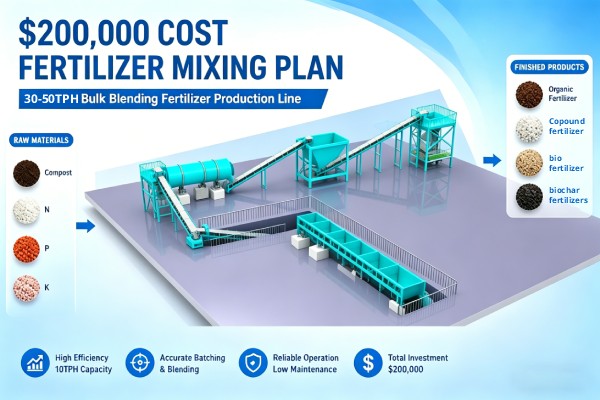
Many buyers care about the bulk blending fertilizer production line price, but the final cost depends on several factors. These include production capacity, automation level, number of batching bins, mixer type, packaging system, conveyor configuration, and electrical control system.
For example, a small semi-automatic line may require a lower budget, while a fully automatic plant with multiple storage bins and high-speed packaging will cost more. A project similar to a $200000 cost blend npk fertilizer project in Malaysia may include automatic batching, blending, conveying, packing, installation support, and spare parts, depending on the detailed configuration.
Easier Operation for Long-Term Business
Automatic BB fertilizer production is not only about saving labor. It also helps you manage production data, reduce human error, and improve product quality control. Operators can change formulas more quickly, monitor the production process more easily, and keep the plant running with fewer interruptions.
For investors who want to enter the fertilizer blending business, choosing a reliable turnkey BB fertilizer plant solution provider is also important. A complete supplier can help with process design, equipment selection, layout planning, installation guidance, and operation training.
Conclusion
An automatic bulk blending fertilizer manufacturing plant is a practical choice for companies that want flexible NPK fertilizer production, accurate batching, lower labor demand, and stable commercial output. If your market needs different fertilizer formulas and fast delivery, automation can help you build a more efficient and competitive fertilizer production business. If you are interested in the project, you can visit https://www.fertilizerbusinessplan.com/fertilizer-blending-plant/