Mineral fertilizer production integrates mining resources and industrial processing technology to create stable, high-value granules that meet sustainable development goals. Modern granulation equipment, especially the disc granulator, plays a critical role in improving efficiency, resource utilization, and product uniformity. Through well-designed granulation machinery and supporting equipment, mineral fertilizer manufacturers can reduce waste, lower energy consumption, and enhance the circular use of mineral resources.
What Types of Raw Minerals Are Suitable for Sustainable Fertilizer Production?
Various mineral materials serve as essential raw inputs for fertilizer manufacturing. Common examples include rock phosphate, limestone, dolomite, and potash ore, each offering distinct chemical properties and industrial benefits. For instance, rock phosphate provides phosphorus sources for phosphate fertilizer production while supporting rock phosphate fertilizer production lines. Limestone supplies calcium and helps adjust soil pH, making it a fundamental material in limestone fertilizer production solutions. Dolomite contributes magnesium, and potash ore introduces potassium for balanced nutrient formulations.
Each mineral type demands specific processing procedures before granulation. The ore fertilizer crusher machine or jaw rock crusher prepares the raw mineral by reducing particle size, ensuring better mixing and uniform granule formation. The Raymond mill further refines mineral powders to achieve consistent quality before the granulation stage. These process steps enable industries to transform mine-derived materials into usable, stable, and recyclable fertilizer particles, supporting long-term mine waste management and sustainable resource recovery.
How Does the Pan Granulator Contribute to Efficient and Sustainable Fertilizer Manufacturing?
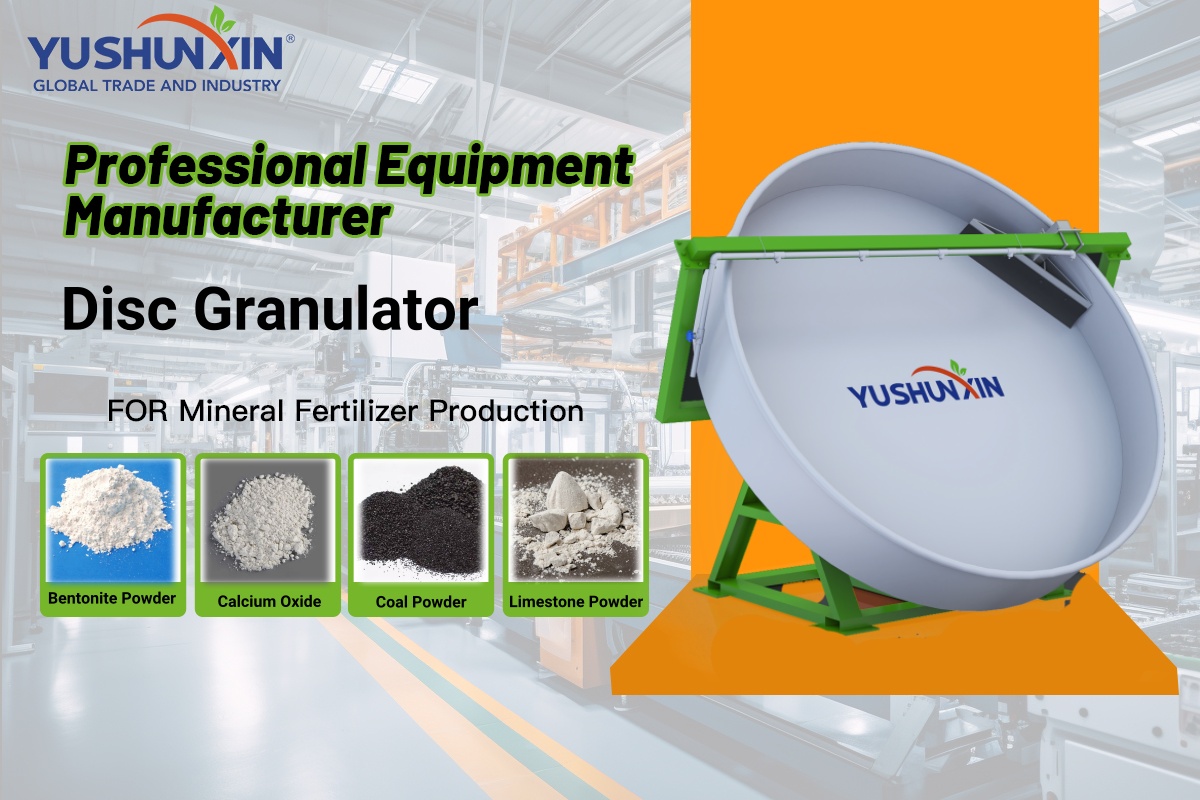
In mineral fertilizer granulation plants, the disc granulator—also known as a pan pelletizer or pellet-making machine—acts as the central unit of the production line. This equipment performs continuous granulation by rotating its disc, allowing fine mineral powders to gather into uniform spheres through controlled moisture and mechanical force. The granulation process reduces dust emissions, minimizes material loss, and delivers consistent granule size, which supports both energy efficiency and environmental compliance.
From a manufacturing perspective, the disc granulation machine provides operational flexibility. Operators can adjust disc inclination, rotational speed, and water addition to accommodate different ore compositions and granule size requirements. Compared with other granulators, this type of pelletizer consumes less energy and simplifies maintenance due to its compact design and stable mechanical performance. By integrating the pan granulator with auxiliary systems such as a screening machine and drying equipment, the entire production line achieves a closed, clean, and resource-efficient workflow.
The granulation process itself transforms mineral dust or powder from mining operations into solid, easy-to-handle pellets, reducing transportation losses and contamination risks. This approach directly supports sustainable production practices by utilizing by-products from the mining and metallurgy sectors, transforming them into valuable fertilizer materials rather than waste.
How Can Integrated Mineral Fertilizer Processing Solutions Improve Sustainability and Product Quality?
Modern mineral fertilizer production increasingly adopts integrated systems that combine crushing, granulating, screening, and drying processes. In a mineral organic fertilizer production line or NPK fertilizer manufacturing plant, the coordination among these machines ensures optimal resource allocation and reduced environmental impact. The ore fertilizer crusher prepares the raw material, the disc granulator forms uniform particles, and the rotary screening machine separates qualified granules from oversized or undersized material for reprocessing.
This integrated operation model enhances production stability, reduces raw ore waste, and lowers dust generation during the pelletizing process. It also allows industries to reuse mineral residues and improve mine waste management practices. When the production line runs under controlled moisture, temperature, and speed conditions, the resulting fertilizer granules exhibit consistent density and strength, improving storage and transportation performance.
Sustainable practices rely on technological innovation and precise equipment design. Advanced granulation machinery provides the foundation for cleaner, more efficient mineral fertilizer production. Through continuous improvement in manufacturing technology, fertilizer producers can achieve balanced economic and environmental benefits while contributing to global sustainability goals.
Conclusion
The future of mineral fertilizer production depends on reducing environmental pressure while maintaining product quality and production efficiency. The disc granulator and its supporting mining fertilizer processing equipment represent essential tools for transforming rock and ore resources into high-value granules. By investing in professional machinery and optimized production systems, manufacturers can achieve long-term sustainability and resource recycling.
A professional fertilizer equipment manufacturer—Yushunxin—provides reliable disc granulation machines, ore fertilizer crushers, and complete mineral fertilizer production solutions to support sustainable industrial growth and responsible mineral utilization. You can visit: https://www.mineralfertilizerproductionsolutions.com/product/disc-granulator-machine/