In industrial fertilizer production, the solubility of lime-based granules determines how effectively nutrients become available during application. The limestone fertyilizer pellet manufacturing process does not merely shape the physical form of lime fertilizer; it influences chemical stability, particle density, and dissolution rates. When a company evaluates the consistency of lime granules, it must consider raw material quality, mechanical design, and production parameters together. A properly controlled manufacturing route ensures that every particle dissolves at the expected rate, providing predictable performance across various applications.
1. What Raw Materials Work Best for Lime Fertilizer Granule Production?
Raw materials directly influence both the mechanical strength and solubility of the final fertilizer particles. Lime rock, limestone powder, and hydrated lime remain the most common mineral sources because each grade provides a different calcium content and reactivity level. For example, limestone powder suits industries that need moderate solubility for steady nutrient release, while quicklime suits sectors that require higher alkalinity correction. Steelmaking, paper processing, and water treatment industries often prefer lime-based fertilizers because these materials can neutralize acidity and enhance calcium supply in their processes. The particle size of the input materials determines the uniformity of granulation, and consistent buffering capacity ensures stable quality across batches. When companies select raw materials carefully, they gain better granule strength and a balanced dissolution curve.
2. How Does the Manufacturing Procedure Shape Granule Solubility and Strength?
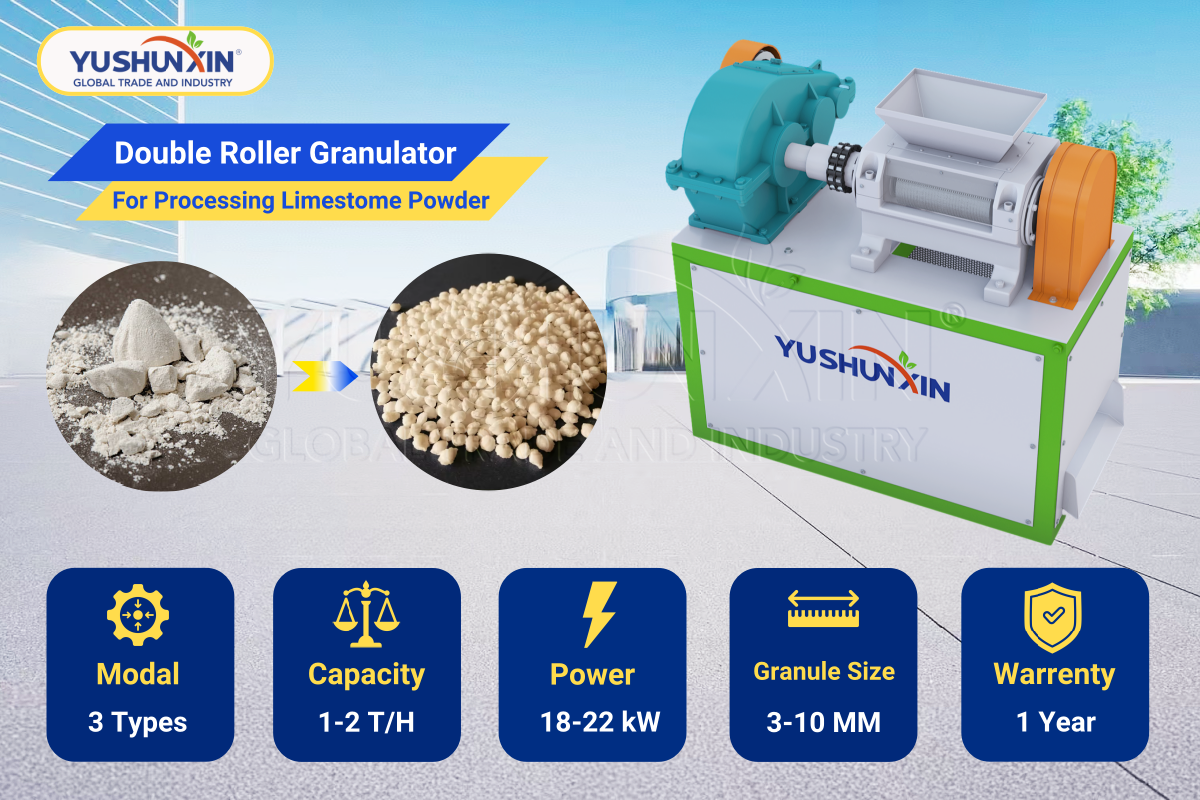
The granulation process decides how quickly lime fertilizer dissolves after application. Each stage—from crushing to formation and screening—affects the internal texture of particles. A typical production line begins with a loader type feeder to maintain constant feeding and continues with a chain crusher that reduces lime rock into fine powder. Then, a horizontal mixer combines limestone with other additives to ensure homogeneity before the mixture enters a double roller extrusion granulator. During this extrusion or dry compacting procedure, high pressure transforms the blended powder into dense pellets. The compact structure reduces dusting and stabilizes solubility. After granulation, a rotary screening machine separates qualified granules from oversize or undersize particles, while belt conveyors transport materials between each stage. Finally, an automatic packaging scale guarantees accurate bag filling for consistent delivery. Every piece of equipment controls temperature, pressure, and moisture levels, and these parameters determine whether the lime fertilizer granules exhibit fast or moderate dissolution once exposed to water.
3. Why Do Machinery Design and Process Parameters Matter for Lime Granule Performance?
The equipment configuration defines the physical integrity of pellets and their dissolution profile. When the extruder applies proper compression through a double roller press, the resulting granule density and porosity remain balanced. High-density compaction improves storage stability but can slow solubility, whereas insufficient pressing leads to weak particles that break down too quickly. The choice of granulator or pelletizer also influences surface smoothness, which affects how water interacts with each granule. Uniform granule size obtained through precise screening improves the spreading rate and ensures predictable nutrient release. Therefore, lime fertilizer granule manufacturing machinery must maintain controlled feed rate, roller pressure, and mixing time to achieve the desired solubility behavior. Modern production lines integrate sensors and automation to monitor these variables continuously, allowing each lime-based fertilizer batch to meet industrial solubility standards.
Conclusion
The solubility of lime fertilizer granules depends on the integration of raw material selection, mechanical operation, and manufacturing control. When industries manage every stage—from the preparation of limestone powder to the final packaging—they secure consistent particle quality and dependable dissolution performance. Professional manufacturers who combine advanced double roller extrusion technology with efficient screening and conveying systems can help clients achieve stable output and reduced waste. A professional fertilizer equipment manufacturer—Yushunxin—provides complete lime fertilizer granulation solutions that emphasize precise process design and durable machinery, ensuring that each lime granule meets the required solubility and strength specifications. You can visit: https://www.extruder-granulator.com/product/limestone-powder-granulation-machine/