Choosing suitable fertilizer production equipment is an important step when you plan to build or upgrade a fertilizer manufacturing project. A well-designed blended fertilizer granulation plant should match your raw materials, production targets, fertilizer formula, and market requirements. Instead of selecting equipment only based on capacity, you need to consider the complete production process and long-term operation needs.
Analyze Your Raw Materials and Fertilizer Requirements First
Before choosing a granulation system, you need to understand the characteristics of your raw materials. Common materials include nitrogen sources, phosphate materials, potassium fertilizers, fillers, and additives. Their moisture content, particle size, flowability, and bonding performance will directly affect equipment selection.
For example, raw materials such as potassium chloride are commonly used as potassium sources in fertilizer production, but different raw materials have different physical properties. Therefore, the crushing, batching, mixing, and granulation sections should be designed according to your actual material conditions.
For projects requiring higher production capacity, a 10 tph blended fertilizer granulation line usually requires accurate batching equipment, continuous mixing, stable granulation equipment, and automatic packaging systems to maintain consistent product quality.
Select a Suitable Granulation Process for Stable Production
The granulation method directly affects fertilizer particle quality, production efficiency, and operating costs. A complete granular NPK blended fertilizer manufacturing process usually includes raw material preparation, crushing, batching, mixing, granulation, drying, cooling, screening, coating, and packaging.
Different projects may require different solutions:
- Dry granulation can reduce moisture requirements and simplify the drying process.
- Wet granulation can improve particle formation when raw materials require additional binding conditions.
- Customized configurations can be designed according to fertilizer type, capacity, and final granule requirements.
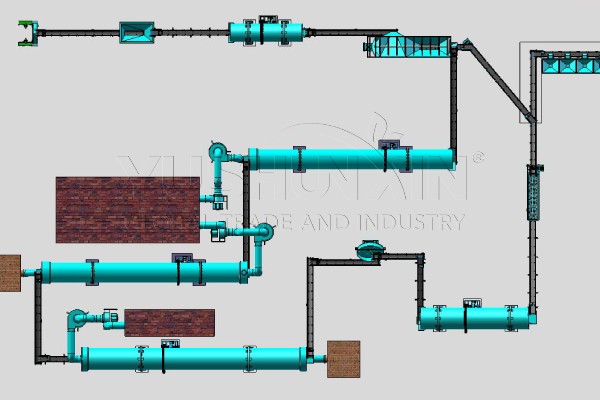
When selecting equipment, you should focus on whether the process can continuously produce qualified fertilizer granules rather than only comparing individual machine prices.
Consider Investment Cost Beyond Equipment Price
Many fertilizer investors pay attention to the initial equipment quotation. However, the actual project investment also includes installation requirements, power consumption, spare parts, maintenance, and future expansion possibilities.
The blended fertilizer pelletizing project cost depends on several factors, including production capacity, automation level, equipment configuration, material selection, and customer-specific requirements.
For a small fertilizer factory, a simple production system may be enough for initial operation. However, large-scale fertilizer manufacturers often need automatic batching, centralized control, and continuous packaging systems to improve production efficiency and reduce manual operation.
Evaluate the Supplier’s Technical Capability
The supplier you choose will influence the success of your fertilizer project. A professional manufacturer should provide more than individual machines. The supplier should understand your raw materials, recommend a suitable process, design the production layout, and provide technical support during installation and operation.
When comparing a blended fertilizer granulation line supplier, you can evaluate several aspects:
- Experience in fertilizer production projects;
- Ability to provide customized solutions;
- Equipment manufacturing capability;
- Technical communication and after-sales support;
- Availability of spare parts and service guidance.
A supplier with complete project experience can help you avoid unsuitable configurations and improve the reliability of your production line.
Conclusion
Choosing the right blended fertilizer granulation equipment requires a comprehensive evaluation of raw materials, fertilizer products, production capacity, investment budget, and supplier capability. A suitable solution should not only meet your current production needs but also support future business development.
Before requesting a quotation, you can prepare information about your raw materials, expected output, fertilizer type, factory area, and automation requirements. This information will help engineers design a more suitable production solution.
More details about the production line are available here:
https://www.mixedfertilizermachines.com/products/blended-fertilizer-granulation-line/